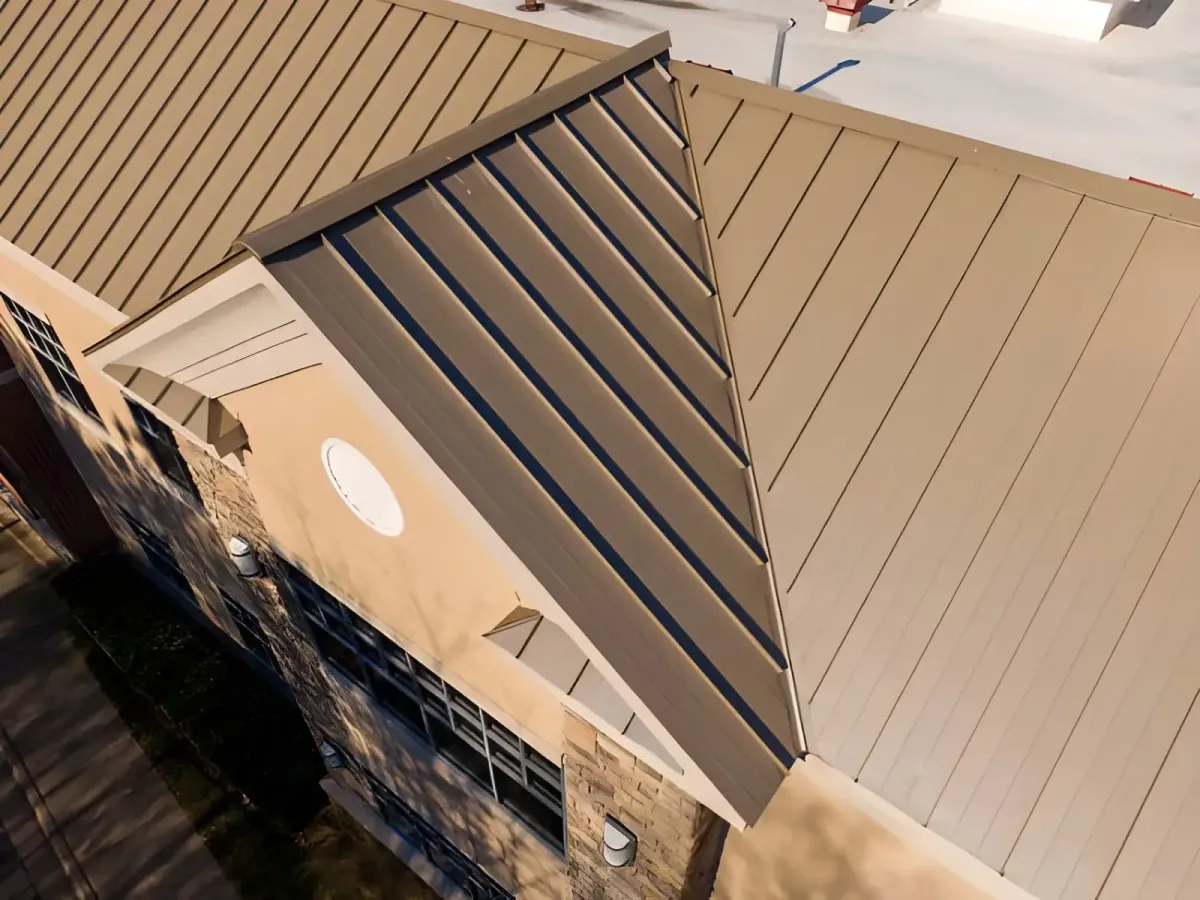
Commercial Roofing La Quinta, CA | Dove Roofing
Dove Roofing and Construction provides the commercial roofing La Quinta CA businesses depend on — including TPO installation, flat roof maintenance, and commercial inspections across the Coachella Valley. Licensed under California Contractor License #871103 and rated 4.5 stars on Google, our team serves commercial properties from Old Town La Quinta to the Highway 111 corridor. Call (760) 702-7633 for a free commercial estimate.
By David Berumen, Owner, Dove Roofing and Construction · Last updated July 10, 2026
What Makes Commercial Roofing in La Quinta Different From Other Markets?
Commercial roofing in La Quinta operates under conditions that expose the limits of systems designed for moderate climates. Rooftop surface temperatures during a Coachella Valley summer routinely exceed 150°F — that is not the air temperature — that is what the membrane itself absorbs on a standard dark-surface commercial roof. UV radiation here is intense enough to degrade poorly specified materials in as few as five to seven years. Then, when monsoon season arrives in July and August, the desert delivers sudden high-intensity rainfall that a flat commercial roof needs to shed quickly and completely — often with no warning.
One more compounding factor: extreme thermal cycling. Overnight temperatures in the Coachella Valley can drop 40°F or more from the daytime peak. That daily expansion and contraction stresses lap seams, penetrations, and parapet flashings relentlessly. Correct seam width, proper primer at terminations, and accurate penetration detailing matter here more than in any temperate California market.
Commercial properties along La Quinta's Highway 111 retail corridor, in the Old Town La Quinta restaurant and shopping district, and across the SilverRock Resort development zone are all exposed to these stressors in the same way. Dove Roofing is among the best commercial roofing companies near La Quinta CA because we install systems specified for this environment — not a generic product approved for a coastal climate. As top-rated commercial roofers in the Coachella Valley, our team understands which membranes, adhesives, and flashing details hold up here over time.

What Is the Best Commercial Roofing Material for Desert Climates?
Which commercial roof system is best for desert climates? The answer depends on the building type, slope, existing substrate, and use — but for La Quinta's flat and low-slope commercial roofs, three systems perform most consistently in the Coachella Valley's conditions.
TPO (Thermoplastic Polyolefin): TPO is the most widely specified commercial flat roof membrane in the Coachella Valley. Its highly reflective white surface deflects rather than absorbs solar radiation — a meaningful performance advantage in a climate where cooling loads drive operating costs year-round. Heat-welded seams create a molecular bond that outperforms adhesive-set alternatives in high thermal-cycling environments. TPO also meets California's Title 24 energy code requirements for commercial cool roofs without requiring additional coatings, which simplifies compliance documentation for La Quinta property owners and their tenants.
PVC (Polyvinyl Chloride): PVC shares TPO's heat-welded seam strength but delivers a different performance profile. PVC membranes resist chemical exposure significantly better than TPO — a critical distinction for restaurant exhaust zones, food service operations, and properties with HVAC condensate discharge points. In Old Town La Quinta, where food and beverage tenants are common, PVC's chemical resistance often makes it the more defensible long-term choice for exposed roof areas near kitchen exhausts.
Silicone Restoration Coatings: For commercial flat roofs that are structurally sound but losing surface reflectivity or approaching the end of their warranted coating life, a spray-applied silicone coating extends the system's useful life at a fraction of full replacement cost. Silicone is UV-stable, fills low-spot ponding areas, and bonds directly to most existing membrane substrates — including aged TPO, modified bitumen, and built-up roofs. We cover the restoration path in detail in a dedicated section below.
How Much Does a Commercial Roof Cost Per Square Foot?
How much does a commercial roof cost per square foot? In the La Quinta and broader Coachella Valley market, commercial roofing costs vary meaningfully by system and condition:
TPO membrane installation: approximately $5–$9 per square foot for a standard 45-mil or 60-mil system over an existing substrate in good condition. Full tear-off, added insulation, or complex parapet detailing increases that figure.
PVC membrane installation: slightly above TPO — typically $6–$10 per square foot depending on membrane thickness and the extent of chemical-resistant detailing required.
Silicone restoration coating: $2–$4 per square foot for an eligible system, which makes it substantially less expensive than a full replacement on the same roof.
Spray foam roofing: $4–$8 per square foot installed, with the benefit of built-in insulation R-value that reduces the separate insulation line item.
These are directional ranges, not fixed quotes. Roof access, parapet height, drain configuration, existing insulation, Riverside County permitting, and Title 24 cool-roof specification requirements all affect the final number. We provide detailed written estimates at no charge for commercial properties in La Quinta and across the Coachella Valley. Call (760) 702-7633 to schedule a commercial walkthrough.
How Long Does a Commercial Roof Last in the Coachella Valley?
How long does a commercial roof last? Manufacturers typically warrant commercial membrane systems for 15–30 years depending on membrane thickness and installation tier. Under La Quinta's UV intensity, the real-world performance of a commercial roof depends heavily on two additional factors beyond the manufacturer's spec: installation quality and ongoing maintenance consistency.
A 60-mil TPO system installed with full-width heat-welded seams, properly primed terminations, and correctly detailed parapet flashings can reach or exceed its 20-year warranted lifespan even in the Coachella Valley's thermal environment. The same membrane installed with narrow seams or skipped primer at roof penetrations may fail in half that time, regardless of what the product data sheet says.
Consistent semi-annual inspections are the other variable. Every commercial roof develops minor seam stress, flashing lift, and debris-blocked drains through normal thermal cycling and monsoon runoff. Catching those conditions at a spring and fall inspection — and addressing them before they become water intrusion events — is what extends a 15-year system to 20 years and a 20-year system to 25.
Can a Commercial Roof Be Restored Instead of Replaced?
Can a commercial roof be restored instead of replaced? In many Coachella Valley cases, yes — and for La Quinta commercial property owners managing deferred maintenance or operating on a capital budget cycle, restoration is worth evaluating before committing to full tear-off and replacement.
Restoration is the right call when the existing system is structurally intact — no delaminated insulation, no ponding water that has been sitting long enough to damage the substrate — but is losing surface reflectivity, showing minor seam separation at field laps, or near the end of its warranted coating life. A spray-applied silicone or elastomeric restoration coating renews the waterproofing surface, restores Title 24 cool-roof reflectivity, and typically extends system service life by 10–15 years at a fraction of replacement cost.
What restoration cannot fix: mechanically failed or open seams, delaminated or saturated insulation, or compromised structural deck. A professional moisture scan — using infrared or nuclear scanning methods to map wet insulation without destructive testing — is the correct first step before recommending restoration versus full replacement on any La Quinta commercial property. We perform commercial condition assessments as part of our free estimate process.

The Coachella Valley Commercial Properties We Serve
As experienced commercial roofing contractors Coachella Valley businesses and property managers can call directly, we serve commercial properties across the valley and greater Riverside County:
La Quinta — Highway 111 retail corridor, Old Town La Quinta, SilverRock development, PGA West resort zone
Palm Desert — El Paseo business district, Monterey Avenue medical and retail corridor
Rancho Mirage — Highway 111 lifestyle retail, medical office parks
Indian Wells — resort properties, conference centers
Indio — industrial and distribution facilities, big-box retail
Cathedral City — mixed commercial and light industrial
Palm Springs — hospitality properties, downtown retail, multifamily
For commercial flat roof Riverside County work outside the Coachella Valley — Riverside, Moreno Valley, Beaumont, Banning — our team serves those markets as well under the same license and insurance coverage.
For guidance on California's Title 24 commercial cool roof requirements that affect membrane specification and energy compliance documentation in La Quinta, the California Energy Commission maintains the current commercial building energy standards.
Frequently Asked Questions
1. What is TPO roofing?
TPO (Thermoplastic Polyolefin) is a single-ply commercial roofing membrane made from a blend of rubber, ethylene, and propylene, installed in large factory-manufactured sheets that are heat-welded at the seams to create a continuous watertight surface. Its highly reflective white surface reduces cooling loads in desert climates and meets California Title 24 commercial energy standards. Property owners in Palm Desert and La Quinta specify TPO roofing most often because of its solar reflectance performance — membranes are available in 45-mil, 60-mil, and 80-mil thicknesses, with heavier gauges providing better puncture resistance and longer warranted lifespans.
2. How often should a commercial roof be inspected?
Twice per year is the professional standard for commercial properties in the Coachella Valley: once in spring before monsoon season begins and once in fall after the rain season ends and before winter maintenance conditions allow easier access. Any significant wind event or storm also warrants a targeted post-event inspection covering penetrations, parapet terminations, and drain cover integrity. The National Roofing Contractors Association recommends a professional inspection at minimum annually for all commercial systems, with biannual inspections for any system over ten years old.
3. What is the warranty on a commercial roof?
Commercial roofing warranties have two distinct layers. The manufacturer's material warranty covers the membrane product against defect — typically 15–30 years depending on membrane thickness and manufacturer tier. The contractor's workmanship warranty covers installation quality — Dove Roofing provides a workmanship warranty on every commercial installation we complete. Full system warranties that combine both material and workmanship into a single guarantee are available from major membrane manufacturers when a licensed contractor installs to their published specification and documented standard. Ask us for specific warranty documentation for the system you're evaluating before making a material decision.
4. Can a commercial roof be restored instead of replaced?
Yes, when the conditions are right. Restoration is appropriate for systems with a structurally intact deck, dry insulation, and a membrane that is still sound but losing surface performance. Silicone and elastomeric coatings extend system life 10–15 years at a fraction of full replacement cost and restore Title 24 cool-roof solar reflectance for compliance purposes. When insulation is water-saturated or the deck is compromised, restoration is not appropriate — full replacement with proper tear-off is the correct path.
5. What is the difference between TPO and PVC roofing?
Both TPO and PVC are single-ply thermoplastic membranes installed with heat-welded seams, and they perform similarly in UV and thermal cycling environments. The meaningful difference is chemical resistance: PVC resists animal fats, oils, and industrial chemicals significantly better than TPO — making it the right choice for restaurant roofs, food processing operations, and any application with chemical exhaust points. TPO is typically 15–25% less expensive than PVC of equivalent thickness and is entirely appropriate for standard retail, office, and light industrial commercial properties in La Quinta where chemical exposure is not a factor. For most Coachella Valley commercial properties, TPO is the right specification. For food service and chemical-adjacent environments, PVC justifies the price difference.
Visit or Call Us
Dove Roofing and Construction P.O. Box 289 Palm Springs, CA 92263 Phone: (760) 702-7633 Hours: Mon–Sat: 7am–7pm | Sun: Closed License: California Contractor #871103
Serving La Quinta, Palm Desert, Rancho Mirage, Indian Wells, Indio, Cathedral City, Palm Springs, and commercial properties throughout the Coachella Valley and Riverside County.
Request a Free Commercial Estimate →
