Skylight Installation in La Quinta, CA: 2026 Guide
Professional skylight installation La Quinta, CA, and across the Coachella Valley requires more than cutting a hole in the roof — it requires desert-specific glazing that meets California Title 24 Climate Zone 15 requirements, proper flashing for our tile and flat roof systems, and sizing appropriate for a climate where the wrong skylight will increase cooling costs by more than the daylighting is worth. Dove Roofing and Construction (CA Lic. #871103, 4.5 stars) is a licensed Coachella Valley roofing contractor serving La Quinta, Palm Desert, and Palm Springs with full skylight installation and roof skylight replacement near me services.
By David Berumen, Owner, Dove Roofing and Construction · Last updated June 2026
Skylights transform living spaces — natural light changes how a room feels and reduces daytime artificial lighting costs year-round. In La Quinta and the valley, the design challenge is maximizing that natural light benefit while minimizing heat gain in a climate that can see 120°F ambient temperatures. This guide covers skylight installation cost in California, which skylight performs best in desert heat, whether you need a specialist or a roofer, and what California's energy code requires for Coachella Valley skylights.
Dove Roofing: (760) 702-7633 | Mon–Sat 7am–7pm
How much does skylight installation cost in California?
How much does skylight installation cost in California? In the La Quinta and Coachella Valley market in 2026:
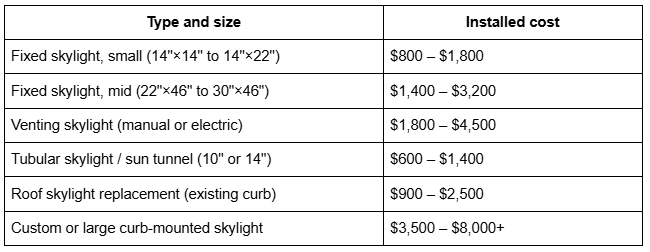
The skylight installation cost includes: the skylight unit, interior light shaft (framing, drywall, and paint where the shaft runs from the roof plane to the ceiling), flashing kit, and California Building Code-compliant installation. Structural reinforcement between rafters is included for standard residential rafter spacing; homes with unusual framing may require additional carpentry.
The Coachella Valley premium over national skylight cost estimates reflects desert-specific requirements: low-SHGC glazing (required under Title 24 Climate Zone 15) costs more than standard glass, and tile roof flashing requires a different approach than the asphalt shingles that most national averages are based on.
What is the best skylight for a hot desert climate?
What is the best skylight for a hot desert climate? — The La Quinta and Coachella Valley answer specifically:
VELUX FS fixed skylights with low-SHGC laminated glass are the benchmark for desert residential skylight installations. VELUX's laminated glass options achieve SHGC values well below the 0.23 maximum required by California Title 24 for Climate Zone 15. The laminated construction also provides safety glass (required by California code for overhead glazing) and UV filtration that protects interior furnishings from desert sun fading.
Tubular daylighting devices (Sun Tunnels / Solatube) are the alternative when minimizing heat gain is the primary concern. A 10-inch or 14-inch tubular skylight delivers diffused, reflected natural light through a highly reflective tube — it doesn't have the visual connection to the sky that a traditional skylight provides, but the small diameter minimizes the thermal penalty. These are the right choice for interior bathrooms and hallways where natural light is the goal, but a full skylight opening would overheat the space.
Fixed vs. venting skylights in the desert: In most climates, venting skylights serve a natural ventilation purpose — opening them allows hot air to escape. In the Coachella Valley's summer, opening a skylight vents 120°F outside air into a cooled interior — the opposite of helpful. Venting skylights are useful for winter ventilation and spring/fall shoulder seasons, but their summer value in the desert is limited. Fixed skylights are typically the right specification for La Quinta primary living spaces.
North-facing skylights dramatically reduce solar heat gain compared to south, east, or west-facing installations. In a La Quinta or Palm Desert roof with a north-facing slope, a skylight on that plane receives minimal direct solar radiation even in summer. Where roof orientation allows it, this is the simplest heat management tool.
What to avoid: Clear uncoated glass skylights, high-SHGC bubble-dome skylights (common in older Coachella Valley homes), and plastic acrylic units — all allow significant heat gain, are non-compliant with current Title 24 requirements, and degrade under desert UV within 5–10 years.
Can a roofer install a skylight, or do I need a specialist?
When Coachella Valley homeowners ask can a roofer install a skylight, or do I need a specialist — the honest answer is that a licensed roofing contractor with skylight installation experience is the right professional for most residential skylight projects, and in some ways better positioned than a window contractor.
Here's why: The most failure-prone element of any skylight is the flashing — the waterproof seal between the skylight frame and the roof surface. On La Quinta's tile roofs, creating that seal requires understanding how the tile system lays, how to integrate a proper flashing pan beneath the tiles, and how to tie back into the tile pattern around the skylight curb. This is roofing knowledge, not window installation knowledge. An inexperienced installer cutting through a tile roof without proper flashing will create a chronic leak point that no amount of sealant will fix permanently.
Dove Roofing installs VELUX skylight installation Palm Desert Palm Springs CA and La Quinta as a complete service: structural header framing between rafters, curb or deck-mount skylight installation to manufacturer specifications, tile-specific flashing integration, interior light shaft framing, and Title 24 permit documentation.
For when you do need a specialist: electrically operated skylights with rain sensors (like VELUX's solar-powered vent skylights) require a licensed electrician for the wiring component. Dove Roofing coordinates with licensed electrical trades for these installations.
Skylight installation La Quinta, CA — Title 24 requirements
For skylight installation La Quinta, CA, and throughout the Coachella Valley, the energy code requirements that apply to every permitted skylight installation:
Climate Zone 15. Per the California Energy Commission, La Quinta, Palm Desert, Palm Springs, Cathedral City, Rancho Mirage, and Coachella are all in Climate Zone 15 — California's hottest residential climate classification. Climate Zone 15 requires skylights to have an SHGC of 0.23 or lower to limit solar heat gain. Any skylight with a higher SHGC requires a performance compliance path (trade-offs elsewhere in the building envelope) — not a practical approach for a single skylight retrofit.
Skylight area limit. Title 24 limits skylight area to approximately 5% of conditioned floor area. For a 2,000 sq ft La Quinta home, that's 100 sq ft of skylight — far more than any typical residential project — but a meaningful constraint for larger commercial or open-plan additions.
Safety glazing. California Building Code requires laminated or tempered safety glass for all overhead glazing. Acrylic dome skylights (common in older Coachella Valley homes) do not meet current safety glazing requirements and cannot be used in new installations or retrofits that require a permit.
Permits. Per the City of La Quinta Building Division, skylight installation that involves cutting through the roof deck and modifying the structural framing requires a building permit. The permit process ensures the structural header framing, flashing, and glazing all meet code. Dove Roofing pulls and manages all required permits as standard practice.
Skylight contractors Coachella Valley, CA — our coverage area
As a skylight contractor Coachella Valley, CA, Dove Roofing serves:
La Quinta — skylight installation La Quinta, CA, our primary eastern valley skylight service area
Palm Desert and Palm Springs — VELUX skylight installation Palm Desert, Palm Springs, CA
Rancho Mirage, Cathedral City, and Indian Wells
Indio and the eastern Coachella Valley
CA License #871103 | Mon–Sat 7am–7pm | 4.5-star rated.
Roof skylight replacement near me — replacing older Coachella Valley skylights
For roof skylight replacement near me in the La Quinta and Palm Desert area, older Coachella Valley homes frequently have:
Acrylic bubble or dome skylights installed in the 1980s–2000s that have yellowed from UV exposure, are non-compliant with current safety glazing requirements, and have degraded seals leaking air and occasionally water. These are almost always the right candidate for replacement — the performance improvement from a current low-SHGC laminated glass unit is dramatic in desert conditions.
Single-pane glass skylights — again, a pre-energy-code installation. Replacement with a current VELUX unit or equivalent immediately brings the skylight into Title 24 compliance and eliminates the solar heat gain that single-pane glass allows.
Replacement vs. retrofit: If the existing skylight curb is in good condition and the dimensions match a current standard unit, replacement uses the existing curb (reducing cost and disruption). If the curb is deteriorated or the dimensions are non-standard, a new curb installation is the right approach. We assess this at no charge during our estimate visit.
Frequently Asked Questions
How much does skylight installation cost in La Quinta, CA?
In 2026, skylight installation in La Quinta runs $800 to $1,800 for a small fixed skylight, $1,400 to $3,200 for a mid-size fixed unit, $1,800 to $4,500 for a venting skylight, and $600 to $1,400 for a tubular sun tunnel. Roof skylight replacement on an existing curb runs $900 to $2,500. The Coachella Valley premium reflects low-SHGC glazing required by Title 24 Climate Zone 15 and tile roof flashing requirements.
Do skylights make a house hotter in the Coachella Valley?
The wrong skylight does — an older acrylic dome or high-SHGC glass unit allows substantial solar heat gain in desert conditions. A properly specified low-SHGC laminated glass skylight (SHGC 0.23 or below as required by California Title 24 for Climate Zone 15) minimizes heat gain while delivering daylighting. North-facing skylight placement dramatically reduces solar load regardless of glazing type. Tubular daylighting devices are the lowest-heat option for spaces where connection to the sky view is less important.
Do I need a permit for skylight installation in La Quinta, CA?
Yes. Skylight installation in La Quinta requires a building permit because it involves structural modification (cutting the roof deck, adding header framing between rafters) and must document Title 24 compliance. Dove Roofing manages the full permit process. Unpermitted skylight installations create disclosure obligations at resale and may not pass appraisal inspection.
How long does skylight installation take?
A standard skylight installation in La Quinta takes 1 to 2 days: approximately half a day for structural framing and skylight installation on the roof, and 1 day for interior light shaft framing, drywall, and finish work. Tubular skylights take 3 to 4 hours total. Complex or large custom skylights may take 2 to 3 days. Permit processing adds 1 to 2 weeks before the installation day.
What type of skylight is best for desert climates in California?
For the Coachella Valley, the best choices are: VELUX fixed skylights with low-SHGC laminated glass (SHGC 0.23 or below) for living rooms and primary spaces; tubular daylighting devices (VELUX Sun Tunnel or Solatube) for interior bathrooms and hallways where minimal heat gain matters most; and north-facing placement wherever roof geometry allows it. Avoid acrylic domes, high-SHGC glass, and single-pane units — all are non-compliant with current Title 24 requirements and perform poorly in desert conditions.
Contact Us
Dove Roofing and Construction P.O. Box 289, Palm Springs, CA 92263 Phone: (760) 702-7633 Hours: Mon–Sat: 7am – 7pm CA License #871103 | Licensed & Bonded | 4.5-Star Rated | Coachella Valley Skylight Contractor
Serving La Quinta, Palm Desert, Palm Springs, Rancho Mirage, Cathedral City, and the Coachella Valley for skylight installation and roofing services.
Request a free skylight estimate or call (760) 702-7633.
